· 6 min read
A Private AI Workspace The Simplest Starting Point for Sensitive Work
James Godwin
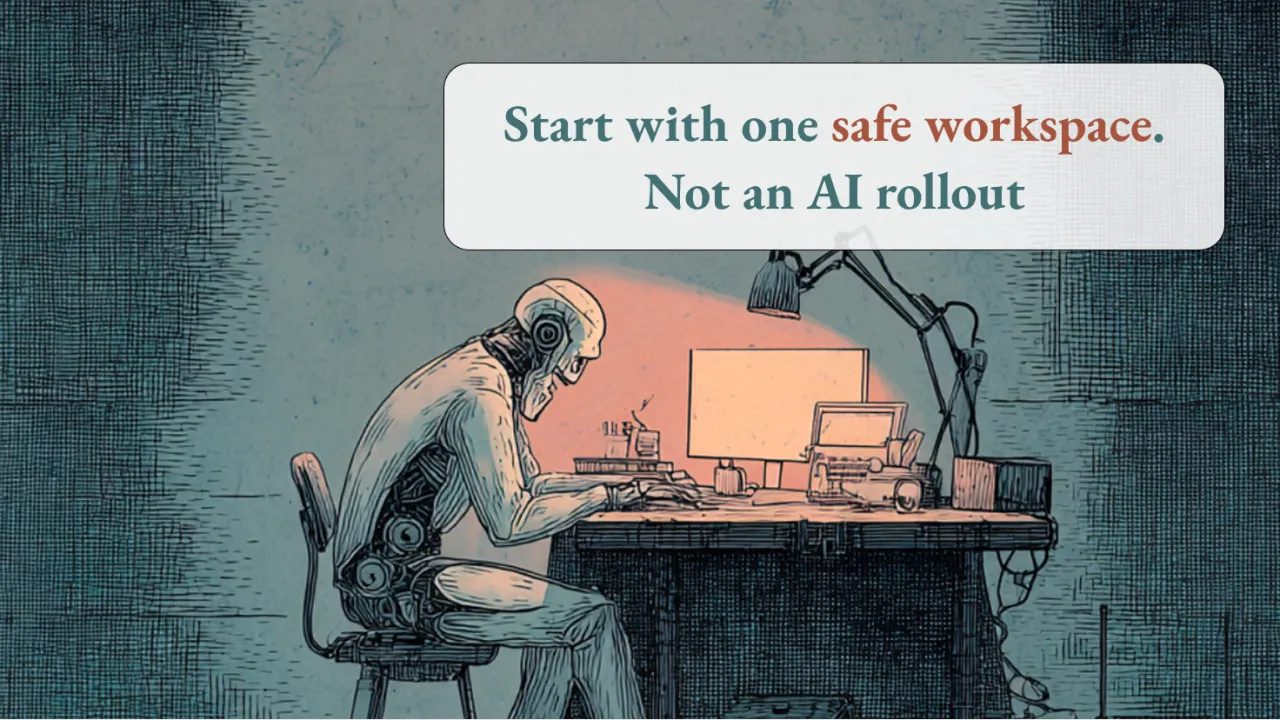
Many businesses think their first AI decision is whether to roll it out widely.
For a firm that handles sensitive material, that is usually the wrong place to start. The more useful first question is much smaller, is there one recurring piece of work where people need help, where the material deserves care, and where we could create a clear approved route instead of leaving everyone to improvise?
That is what I mean by a private AI workspace. It is not a grand transformation programme. It is not a promise that every document can now be processed automatically. It is one bounded place for one kind of work, with clear material, a clear task, and a person still responsible for the result.
This distinction matters because most firms are already caught between two unhelpful positions. One is to avoid AI altogether because the risks feel too vague and too large. The other is to let people explore whatever tools they can find, then hope common sense will hold the boundary. Neither position gives a team a reliable way to use the technology when the pressure of ordinary work arrives.
That pressure is usually very ordinary. A client has sent a long pack of documents before a meeting. Notes from several people need to become a usable brief. Two versions of an agreement need comparing. A messy set of correspondence contains dates, decisions, open questions, and actions that someone must reconstruct before the next call. The work is repetitive, mentally noisy, and often time-sensitive.
When people reach for an AI tool in those moments, they are not necessarily making a statement about technology. They are often trying to create orientation before a deadline. They want a first-pass summary, a chronology, a list of missing information, or a rough draft that helps them see the work more clearly.
That is why a policy alone is rarely enough. A policy may say that public AI tools are not approved for sensitive material, and in many cases that boundary is sensible. But the policy does not remove the work that made the shortcut attractive. If the business has not designed a usable alternative, the pressure remains. People may avoid AI completely and lose a useful form of support, or they may begin making small private exceptions because the task still has to be finished.
A private workspace gives the business a third option. Instead of treating AI as an unrestricted assistant with access to everything, the firm creates a narrow environment beside its existing systems. It might hold copied sample material or an approved set of documents for one live workflow. It might be available to a small group of people. It might be limited to summarising, extracting, comparing, searching, or drafting a first-pass internal brief.
The important word is bounded. The workspace does not need access to every shared drive, inbox, client record, or source-of-truth system. It does not need to make decisions, send messages, or update records automatically. Its job is to help a person get from a known set of material to a clearer reviewed starting point.
Imagine a small advisory firm preparing for a client meeting. Instead of reopening a chain of emails, several attachments, and old notes from scratch, a consultant could place an approved set of copied material into one workspace and ask for a short meeting brief. The result might pull out the main issues, dates, named people, missing items, and questions that need answering. The consultant then checks it against the source material, corrects what is wrong, adds their own judgement, and saves the final brief where the normal process expects it.
Nothing in that example removes professional responsibility. The AI is not deciding what advice to give. It is not making a legal, financial, clinical, or leadership judgement. It is not quietly becoming the system of record. It is helping with the first layer of orientation, while a person remains accountable for what happens next.
That is a much more honest way to introduce AI into sensitive work. It lets a business learn from one real workflow without pretending that the technology is either harmless or magical. The team can see where the tool is useful, where it misunderstands context, what material should never enter the workspace, and which review steps cannot be skipped.
It can also reveal a problem that existed before AI. A pilot often exposes scattered files, weak naming conventions, unclear ownership, or templates that no longer match how the work is actually done. That is not a failure of the experiment. It is useful evidence. If a workflow is too messy for a bounded assistant to work with safely, it may also be too messy for people to work with consistently under pressure.
This is why I prefer the idea of a workspace to the language of an AI rollout. A rollout makes the conversation sound like a technology adoption exercise. A workspace makes it sound like what it is: a small piece of operating design. The business is deciding what material belongs there, what task is allowed, who can use it, where the output goes, and where human judgement must take over.
That design work is more important than choosing a fashionable model. Model choice matters, but it is only one layer. The real question is how the workflow behaves when someone is busy, uncertain, and trying to finish a piece of work. Is the approved route clearer than the unofficial shortcut? Can a person tell what the system has seen and what it has not? Can they check the output before it affects a client, colleague, or decision? Does the process leave a trail that makes sense afterwards?
The answers will differ between firms. Some businesses may decide that a carefully governed cloud tool is appropriate for certain non-sensitive work. Others may need a more controlled local setup for repetitive, confidentiality-heavy tasks. Some work should remain human-only because the stakes, ambiguity, or source material make AI assistance a poor fit. A private workspace is not an argument against cloud tools. It is a way of becoming more deliberate about where each kind of work belongs.
Starting small also changes the quality of the decision. Instead of buying a large system or writing a sweeping policy, a firm can choose one pressure point and test it with care. Use approved or sample material. Define one task. Give the workspace clear boundaries. Review every output closely. Notice whether it reduces repeated reading without weakening trust or creating new confusion.
If it does not help, stop. That is a useful outcome. The business has learned that the workflow needs a different intervention, perhaps a better template, clearer ownership, cleaner source material, or no AI at all. If it does help, the firm has something more valuable than enthusiasm. It has evidence from its own work and a starting point it can refine before expanding.
For many sensitive businesses, this is the simplest way through the noise. They do not have to decide whether they are for AI or against it. They can decide whether one recurring task deserves a safer, clearer route than public improvisation.
That is not a full AI strategy. It is the beginning of one.
If you lead a confidentiality-heavy business, which recurring task would be a sensible place to test one approved, reviewed AI workspace?