· 3 min read
Where My Breath Sits
James Godwin
There is a moment in my Tai Chi class that I see again and again with new students.
We stand in a posture called ward off, with the arms held in front in a loose circle. Someone new is usually working hard at it, and you can see it in their shoulders. I walk over, pinch the sleeves of their top between my fingers, and ask them to relax.
“I’m relaxed,” they say.
So I let go of the sleeves, and their arms stay up.
If the arms were fully relaxed, they would flop down. They don’t. Even when I hold their arms and ask them to give up completely, the moment I let go they catch it. The tension comes straight back, and they don’t feel it happen.
That is the part that interests me. You think you’re relaxed, but you’re not. The tension has been there long enough that it feels like the normal shape of things.
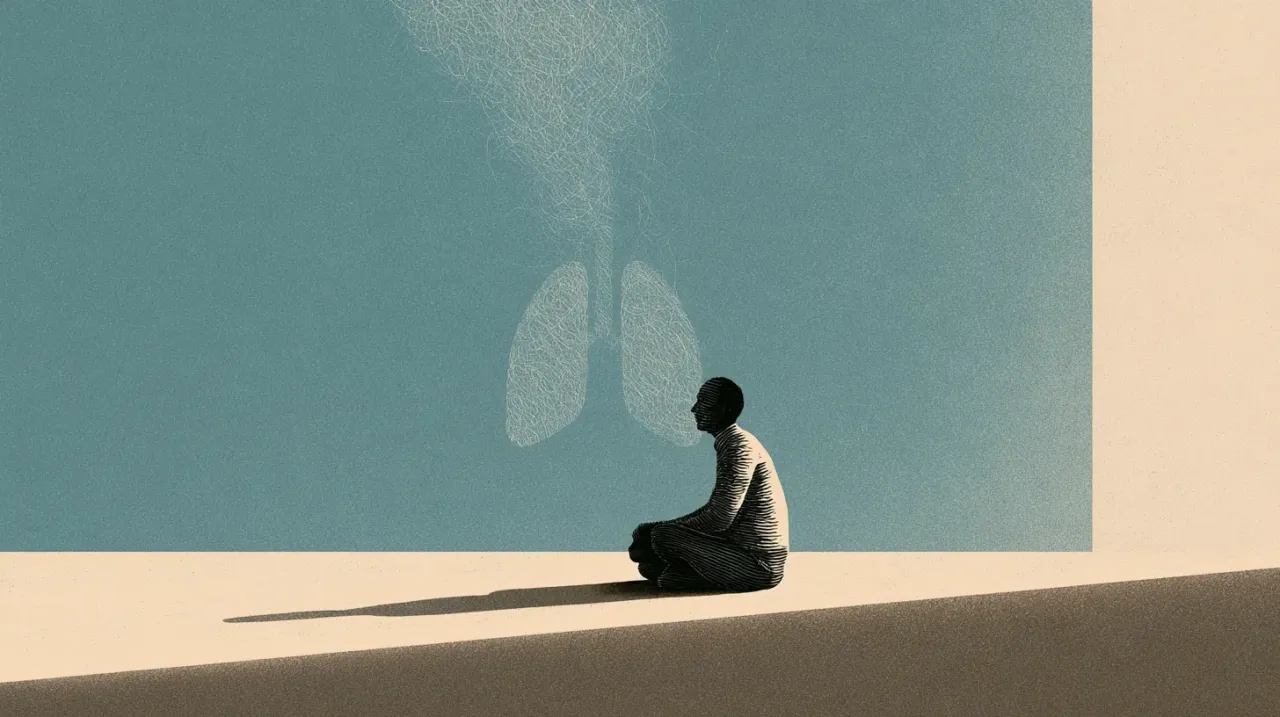
I’ve practised Tai Chi for more than 30 years, in the Cheng Man-Ching lineage, and the breathing we use sits low in the belly, in the dantian. New students often struggle to lower the breath there. Some think it’s impossible. For me, the breath not being in the dantian is one of the clearest signs that I’m carrying tension, even when I would tell you I’m relaxed.
The same thing shows up in the qigong we do. In the opening move the arms rise and fall, and when the arms slow down, the breath slows with them. When we stretch our hands above our heads, the body tightens and the breath rises with it. More advanced students keep the relaxation as the arms go up. Most of us can’t at first, and that is useful to feel.
None of this stays in the class. I check in with my breath often through the day, and sometimes I don’t notice that it has shifted. It has crept up into my chest while I was busy with something else.
When I do notice, I don’t chase the reason. It may be stress my conscious mind hasn’t processed yet, and working out why isn’t really the point. I stand up, or I simply become aware of it, and lower the breath back down to the dantian. Stomach breathing. I do the same when I’m walking.
Other times I notice and ignore it, because I’m preoccupied. Then I get cross with myself. Slow down, get presence back to the breath. Life pulls me along again, and a while later I catch it again.
I’ve stopped expecting to get this right. It isn’t about perfection. It’s about catching it.
I often say something like this to new students. After this hour you might never do Tai Chi again, and that’s fine. But one day you’ll be driving out with your hands on the steering wheel, or pushing a trolley in the supermarket, and you’ll think, what was that guy saying about breath? And you’ll notice, oh, it’s in my chest.
I’m careful with what comes after that, because it isn’t a judgement. The breath isn’t bad in the chest and good in the stomach. If it’s high, there is generally some tension somewhere. It could be mental, physical, emotional or spiritual. I don’t think it matters which. It isn’t about identifying why. It’s only about noticing that it has shifted.
I think about that student with their arms still floating after I let go of the sleeves. Nothing went wrong in that moment. They were simply shown something that was already there.
That is most of what I hope people take from the class, and most of what I’m still practising myself. Not a technique to fix anything. Just recognising where my breath sits, and coming back to it when I notice.
If you’d like future essays and notes in your inbox, subscribe by email ↗.
More essays
· Design & development
The app is the visible part
Read essay
· Design & development