· 7 min read
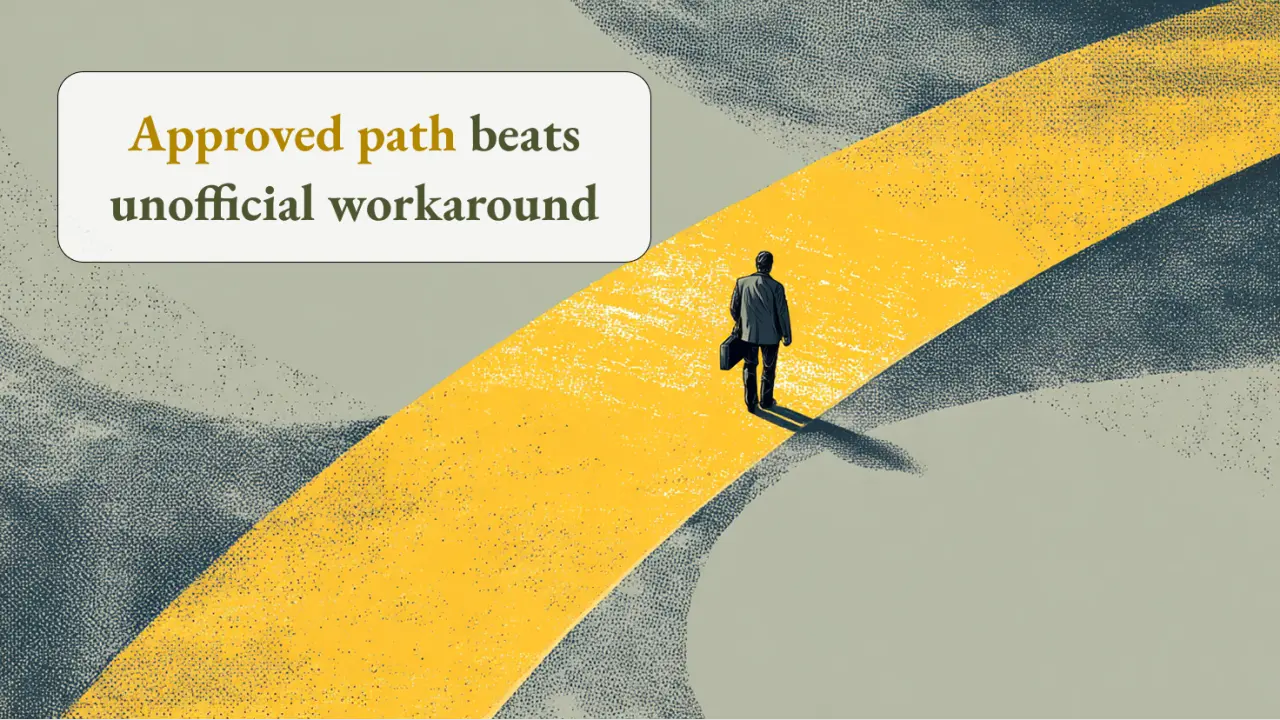
A ban is not a workflow. Pressure routes around it.
James Godwin
One of the most common early reactions to AI inside a professional business is simple, ban ChatGPT.
That reaction is understandable. If a law firm, financial practice, accounting team, health business, HR function, or consulting group handles sensitive material every day, public AI tools can feel like an obvious new exposure. The owner or partner imagines confidential documents being pasted into a cloud service, with unclear retention, unclear routing, and unclear downstream consequences. So the quickest response is often a policy line that says some version of: do not use it.
The problem is that a ban answers the technology question faster than it answers the workflow question.
People do not reach for AI because they are ideologically committed to the tool. They reach for it because they are under pressure. A long document needs summarising before a meeting. A pack of correspondence needs key dates and actions pulled out. A client update needs drafting from scattered notes. Two versions of a policy need comparing before sign-off. The work is repetitive, the deadline is close, and the existing process is slower than the pressure feels.
If the business only creates a prohibition, the pressure does not disappear. It usually goes underground.
That is the part many leaders miss. The risk is not only that someone may deliberately ignore the rule. The deeper risk is that the organisation has not designed a usable path for the kind of work that made the tool attractive in the first place. When that happens, staff begin improvising. They paste smaller excerpts instead of full files. They remove names and hope that is enough. They use personal accounts. They try one task “just to see”. Or they avoid AI publicly while continuing to struggle through document-heavy work with no better option.
In other words, the ban may reduce visible use while increasing hidden use.
That is why the more useful question is not, “Should we allow ChatGPT or ban it?” The more useful question is, “Which workflows are creating the pressure, what makes them sensitive, and what safer route could we design instead?”
Designing a safer workflow does not begin with enthusiasm for AI. It begins with honesty about work. Where are people already losing time? Which tasks are document-heavy, repetitive, and mentally noisy? Which materials should not casually leave the business? What would a reviewed, usable output look like? Where should that output be saved? Who needs to approve it?
That framing changes the conversation immediately.
Instead of debating AI in the abstract, the business starts describing one real operating problem. A partner wants a matter summary before a call. An accountant needs a first-pass overview of documents that arrived in fragments. An adviser wants a reviewed preparation brief before a client meeting. An operations lead needs to compare versions of a policy or contract. A health practice wants help structuring non-diagnostic intake information without blurring the clinical boundary. These are not science-fiction use cases. They are ordinary friction points.
Once the problem is concrete, the safer route becomes easier to see.
A business might decide that one class of approved work should happen inside a controlled local workspace rather than an open public tool. That workspace could sit on an office machine or internal appliance, accessed through a browser on normal staff laptops. It could contain copied sample documents or approved material for one narrow task. The AI does not need broad access to every folder, inbox, or system. It is pointed at a bounded set of material, asked to do one job, and its output is reviewed by a person before anything is reused.
That workflow is slower to set up than a ban, but far more believable in practice.
It also respects something important about human behaviour. Most people are not trying to create confidentiality risk. They are trying to finish work inside the time and complexity available to them. If the safest route is also unusable, the business should not be surprised when people drift toward the route that feels usable. A safer workflow works because it gives staff a path that is both clearer and more realistic under pressure.
This is where many AI conversations become distorted by product language. People talk as if the key decision is choosing the right model. In most professional settings, the model is only one layer. The real design problem is the stack around it: hardware, permissions, approved folders, retrieval, templates, review rules, logging, output handling, and the practical boundaries of who can do what.
That is why “banning ChatGPT” and “designing a safer workflow” are not opposite branding choices. They belong to two different levels of thought.
The ban is a surface rule. The workflow is an operating design.
Surface rules have their place. A business may absolutely need to say that specific tools or uses are not approved. But if that is the only intervention, the organisation is still relying on restraint where it should be providing structure. The stronger move is to pair boundaries with routing. Some work stays out of AI entirely. Some non-sensitive work may happen in approved cloud tools. Some sensitive, repetitive, context-heavy work may justify a more controlled local path. The business becomes clearer not because it picked a side in an AI argument, but because it decided where work belongs.
That routing mindset is often much more useful than ideology. A firm does not need to become anti-cloud to behave intelligently. It needs to understand the difference between public brainstorming, approved drafting, and confidentiality-heavy document work. It needs to know when convenience is acceptable, when control matters more, and when the correct answer is still human-only.
There is also a leadership issue here.
When leaders ban a tool without understanding the pressure behind its use, they often create a culture of concealment. Staff learn that experimentation is embarrassing, questions are risky, and the only safe answer is to say nothing. That does not produce trustworthy operations. It produces polite opacity.
A safer workflow can change that culture. It gives people language for the real problem. They can say, “This task keeps creating pressure,” or “We need an approved route for this kind of document summary,” instead of quietly testing tools in the shadows. The organisation learns where the friction actually is. That learning is worth something even before AI adds any benefit, because it exposes which workflows were already brittle.
Seen this way, AI can become a diagnostic tool for operational weakness.
The staff member reaching for ChatGPT is often pointing, however imperfectly, at a task the business has not designed well enough. The answer is not always to automate that task. Sometimes the better answer is to simplify the process, improve the template, clean up the source material, or clarify ownership. But the signal is still useful. It shows where pressure is outrunning process.
This is another reason blanket bans can be too crude. They suppress the symptom without helping the business inspect the underlying strain.
None of this means every firm now needs a local AI appliance, a private model stack, or a large internal experiment. In some organisations, the right answer will be simpler. It may be a clearer approved cloud policy, better staff guidance, and a firm rule against using sensitive material. In others, especially where confidential, repetitive, document-heavy work is constant, a local workflow may be worth testing precisely because it creates a narrower and more inspectable route.
The sensible first move is usually small.
Pick one recurring workflow. Use sample or approved material. Define the task. Keep the workspace bounded. Review the output closely. Notice where the result helps, where it fails, what still requires judgement, and whether the workflow genuinely reduces repeated effort without weakening trust. If it does not, stop. If it does, refine the design before expanding the scope.
That is a very different posture from rolling out AI because it feels inevitable, and it is also very different from banning it because it feels risky.
It treats the business as something that can learn.
In confidentiality-heavy firms, that learning posture matters. The goal is not to look progressive, and it is not to look cautious. The goal is to make better decisions about where pressure, trust, and useful automation meet. Sometimes that will lead to saying no. Sometimes it will lead to a controlled experiment. Sometimes it will reveal that the real opportunity is not a new model at all, but a cleaner workflow that should have existed anyway.
That is the difference I keep coming back to. A ban tries to remove the tool. A safer workflow tries to understand the work.
The second approach is slower, but it gives a business something much more valuable than a rule. It gives it a path.
If you lead a confidentiality-heavy business, which recurring task is currently creating enough pressure that people may already be looking for unofficial AI help?